
The Fed Raised Interest Rates. What Does That Mean for You?

David Eltringham
Managing Director, Sr. Wealth Advisor
In a unanimous decision, the Federal Open Market Committee (FOMC) voted to raise rates by 25 basis points, bringing the federal funds target range to 3.75%-4.00%. While the move was largely anticipated, it marks an important shift in the interest-rate environment and raises questions about what comes next for consumers, businesses, and investors.
Consumers are already feeling the pressure of higher prices. Inflation rose 3.4% over the 12 months ending in August, but the pressure has been particularly pronounced in energy: energy prices are up 16.3% from a year ago, while gasoline prices have risen 27.4%.¹
Against that backdrop, raising interest rates may seem counterintuitive. If households are already paying more for energy, food, housing and other necessities, why intentionally make borrowing more expensive? It comes down to demand.
Higher rates are designed to make consumers and businesses a little more selective about where they spend and invest. Changes in the federal funds rate influence broader financial conditions and, in turn, the spending decisions of households and businesses.² Multiply those decisions across the economy and demand begins to cool. In theory, that takes some pressure off prices.
We often hear this described as the Fed “tapping the brakes” on the economy. We think that’s a useful analogy, because the real question isn’t whether the Fed wants the economy to slow. The question is how hard it needs to press the brakes to get inflation under control.
Press too lightly and inflation may remain stubborn. Press too hard and an intentional slowdown can become something much more significant. That’s the balancing act the Fed is facing today.
What Happened the Last Time the Fed Raised Rates?
We don’t have to go back very far to see what that balancing act looks like.
The last major rate-hiking cycle began in March 2022, when inflation was running at levels we hadn’t seen in decades. By June, headline inflation had reached 9.1% year over year—the largest 12-month increase in the Consumer Price Index since November 1981.³
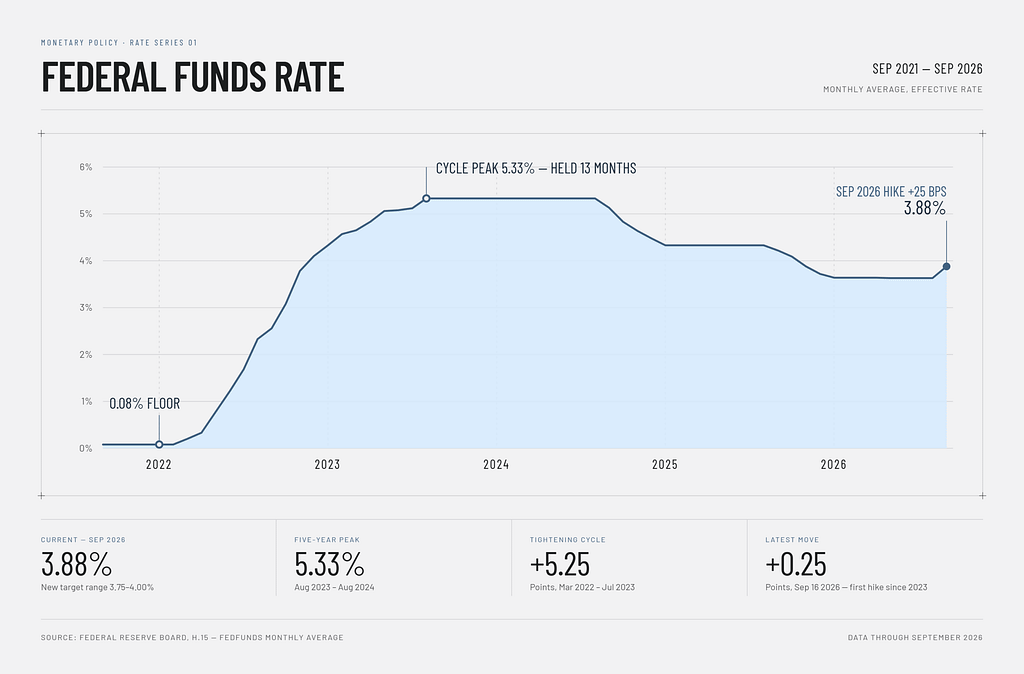
The Fed responded aggressively, raising its target range from 0.25%–0.50% in March 2022 to 5.25%–5.50% by July 2023. That included four consecutive 75-basis-point increases between June and November 2022.⁴
Borrowing became substantially more expensive, and interest-rate-sensitive areas of the economy began to respond. By early 2023, Federal Reserve policymakers noted that cumulative monetary tightening had already reduced demand in interest-rate-sensitive sectors, particularly housing.⁵
Financial markets had to adjust as well. Higher yields created more competition for equities, while rising rates put downward pressure on the market value of many existing fixed-rate bonds.⁷
But we also shouldn’t assume this cycle will follow the same script. Today’s consumer is in a different position. The sources of inflation are different. Geopolitical uncertainty is different. And the economy is starting from a different level of interest rates.
History gives us perspective. It doesn’t give us a roadmap.
What Does This Mean for You?
Consumers are unlikely to feel the full impact of a rate hike overnight. Some borrowing costs can respond quickly—or even before the Fed acts as markets anticipate the decision—while the broader effects tend to work their way through the economy over time.
The most noticeable changes are likely to appear first in interest-rate-sensitive areas such as housing, automobiles and other large financed purchases. Prospective homebuyers may face higher financing costs and reduced purchasing power, while credit cards, HELOCs and other variable-rate debt may become more expensive to carry.
The effects can become more significant if higher rates remain in place. Businesses facing higher financing costs may reconsider expansion, equipment purchases or new projects. That can eventually flow into the labor market through slower hiring, fewer job openings or, if economic conditions weaken enough, layoffs. Construction, real estate, manufacturing and other industries tied closely to financing and large capital investments can be particularly sensitive.
What Does This Mean for Your Portfolio?
Stocks: The Hurdle Gets Higher
Higher rates increase the cost of capital for businesses. Companies with strong cash flow, healthy balance sheets and limited refinancing needs may be better positioned than businesses that depend heavily on outside financing – like small and mid-cap companies.
Valuations can also face pressure. As Treasury yields rise, investors may demand a greater potential return from stocks to justify taking additional risk. That doesn’t mean a Fed hike automatically sends stocks lower. Markets are forward-looking, and an expected increase may already be reflected in prices.
That’s why we’re paying close attention to what comes next—particularly the pace and path of future rate changes.
Bonds: Don’t Miss the Other Side of the Story
Rising rates can put pressure on existing bond prices, particularly longer-duration bonds. But that’s only half of the story. Higher rates also create opportunity.
New bonds can offer more attractive yields ranging from tax-free municipal bonds to investment-grade corporate bonds. This gives investors the potential to generate increased cash flow from fixed income than was available during the lower rate environment.
For years, investors seeking meaningful returns often had to accept additional risk because high-quality bonds offered very little yield. Higher rates change that equation.
Fixed income is competing for investor capital again—and that’s meaningful for portfolio construction.
What Should Investors Do?
Periods of changing interest rates can create significant movement across stocks, bonds and other asset classes, but that does not necessarily mean investors should make dramatic changes in response to a single Fed decision.
In fact, environments like this reinforce the importance of diversification. Different investments respond differently to higher rates. Certain stocks may face greater pressure, while higher yields can create new opportunities in fixed income.
Interest-rate environments change. Markets adjust. Investment opportunities evolve. Your financial plan should be built to reflect that.
If you have questions about how higher interest rates may affect your portfolio, borrowing decisions or broader financial plan, our team at Benchmark Wealth is here to help you understand what these changes mean for you and determine whether any adjustments are appropriate.
Sources
- S. Bureau of Labor Statistics, Consumer Price Index — August 2026, September 11, 2026.
- Board of Governors of the Federal Reserve System, The Fed Explained: Monetary Policy.
- S. Bureau of Labor Statistics, Consumer Price Index — June 2022, July 13, 2022.
- Board of Governors of the Federal Reserve System, Open Market Operations — FOMC Target Federal Funds Rate or Range, 2022–2023.
- Board of Governors of the Federal Reserve System, Minutes of the Federal Open Market Committee, January 31–February 1, 2023.
- S. Securities and Exchange Commission, Investor.gov, Fixed Income Investments — When Interest Rates Go Up, Prices of Fixed-Rate Bonds Fall.
- Board of Governors of the Federal Reserve System, FOMC Statement, July 26, 2023.
This material is provided for informational purposes only and should not be construed as investment advice, a recommendation, or an offer to buy or sell any securities. The views expressed herein are those of the author as of the date of publication and are subject to change without notice based on market and other conditions.
All investments involve risk, including the potential loss of principal. Past performance is not indicative of future results. There can be no assurance that any investment strategy will be successful.
The information contained herein has been obtained from sources believed to be reliable, but its accuracy and completeness are not guaranteed. Any forward-looking statements or projections are based on current assumptions and expectations and are subject to change. Actual results may differ materially.
References to specific asset classes, sectors, or market developments are for illustrative purposes only and should not be considered a recommendation to invest. Diversification does not guarantee a profit or protect against loss in declining markets.
Fixed income investments are subject to interest rate risk, credit risk, and inflation risk. Equity investments are subject to market volatility and company-specific risks. Investments in international and emerging markets may involve additional risks, including currency fluctuations, political instability, and less developed regulatory environments.
This communication is intended for a broad audience and does not take into account the specific investment objectives, financial situation, or needs of any individual investor. Investors should consult with their financial advisor before making any investment decisions.
Benchmark Wealth is a Registered Investment Advisor. Registration with the SEC or any state securities authority does not imply a certain level of skill or training.
