
Q3 2026 Market Commentary
Beyond the Headlines: What Q3 2026 Revealed About Markets
On paper, the third quarter looked relatively calm. The S&P 500 gained 2.0%, bringing its year-to-date return to 11.8%. Underneath that number, however, the story was much more interesting.
Interest rates moved sharply higher. Oil prices climbed as tensions in the Middle East intensified. The Federal Reserve raised rates for the first time since 2023. And once again, a relatively small group of large technology companies accounted for much of the market’s strength.
At the same time, the U.S. economy continued to hold up better than many expected. For investors, that leaves us with an unusual mix: a resilient economy, higher interest rates and a stock market that looks stronger at the surface than it does underneath.
The Quarter at a Glance
Index/Benchmark
Q3 2026
Year to Date
S&P 500
+ 2.0%
+ 11.8%
Nasdaq
+ 2.5%
+ 15.6%
Dow Jones Industrials
– 2.7%
+ 5.9%
Russell 2000
– 7.5%
+ 12.7%
U.S. Bonds
– 3.5%
– 2.9%
The Market Rose. Most Stocks Didn't.
The S&P 500 gained 2.0% during the quarter, and the Nasdaq rose 2.5%. But smaller U.S. companies fell 7.5%, and fewer than 40% of the companies in the S&P 500 actually posted a gain. That may sound contradictory. How can the S&P 500 rise when most of the companies inside it don’t?
The answer comes down to how the index is constructed. The largest companies carry significantly more weight than smaller ones. When a handful of companies such as the major technology and AI leaders perform well, they can pull the entire index higher even while many other stocks struggle. That is essentially what happened in Q3.
We don’t view that as an immediate warning sign. Looking at the S&P 500 alone right now can make the market appear healthier than the experience of the average stock would suggest. And it reinforces something we talk about often: leadership changes.
The companies leading the market today will not necessarily be the ones leading it several years from now. That’s one reason we continue to believe owning a broad mix of investments matters.
The Cost of Money Moved Higher
Interest rates were another major story this quarter.
In September, the Federal Reserve raised its benchmark rate by 0.25%, bringing the federal funds target range to 3.75%–4.00%. It was the Fed’s first increase since 2023. Meanwhile, the 10-year Treasury yield climbed to roughly 5.3%, its highest level since 2002. That changes the financial landscape in ways that extend well beyond the Fed.
For consumers, higher rates can mean more expensive mortgages, car loans and other forms of borrowing. For businesses, financing a new project or expansion becomes more expensive. For investors, there is another side to the story.
For much of the past decade, earning a meaningful return from conservative investments was difficult. With interest rates where they are today, investors can earn considerably more from cash and high-quality bonds. That means stocks have competition again.
If an investor can earn an attractive yield from a high-quality bond, taking the additional risk of owning a stock needs to offer enough potential reward to make that risk worthwhile. That doesn’t make stocks unattractive. It simply changes the calculation—and gives investors more options than they had when interest rates were near zero.
Oil Is A Problem Interest Rates Can't Solve
The Fed’s challenge became more complicated during the quarter as oil prices moved sharply higher. Brent crude rose roughly 42%, moving from the low $70s to above $100 per barrel as conflict in the Middle East intensified and concerns grew around global oil supplies. Higher oil prices matter for more than what we pay at the gas pump.
Energy is involved in producing, transporting and delivering goods throughout the economy. When energy becomes more expensive, those costs can eventually find their way into the prices consumers pay. And that creates an uncomfortable situation for the Federal Reserve.
The Fed can influence demand. It can’t create more oil. Raising rates can discourage borrowing and spending, which can help cool inflation. But interest rates cannot resolve a supply disruption or geopolitical conflict.
If energy prices remain elevated, the Fed may be forced to balance two competing risks: allowing inflation to remain too high or raising rates enough that economic growth begins to suffer. We think that balancing act will be one of the most important stories to watch through the end of the year.
The AI Boom is Becoming an Economic Story
AI remains one of the dominant investment themes of the past several years. But increasingly, this is about more than stock prices. Alphabet, Amazon, Meta, Microsoft and Oracle are expected to spend an estimated $800 billion this year, much of it on data centers and the infrastructure needed to support artificial intelligence.
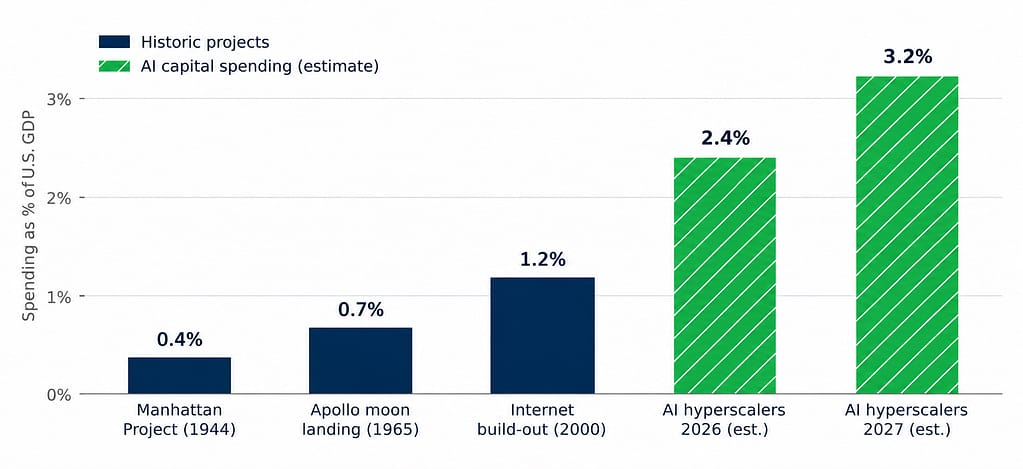
Big-company AI Spending vs. History’s Largest Projects
Source: Capital Group, citing Brookings, CBO, FactSet, Federal Reserve Bank of St. Louis, The Planetary Society, U.S. Census Bureau. 2026–2027 figures are sell-side consensus estimates as of 9/25/2026.
The scale is difficult to appreciate until you put it into context.
The chart compares AI-related investment with some of the largest projects in modern American history. Relative to the size of the economy, estimated AI spending is already on a scale that rivals those historic investments.
That money doesn’t disappear into a computer. It goes toward land, construction, semiconductors, electrical equipment, energy infrastructure, employees and countless other inputs. That helps explain why AI is increasingly contributing not only to corporate earnings, but to broader economic activity.
There is, however, an important question investors shouldn’t ignore: What return will companies ultimately earn on all of that spending?
The potential of AI may be enormous. So is the amount of money being invested to capture it. For now, earnings have continued to support optimism. Over time, though, companies will need to demonstrate that the economic benefits justify the investment—and the expectations already reflected in their stock prices.
The Economy Keeps Defying Expectations
Given everything consumers and businesses have absorbed over the past several years, the resilience of the U.S. economy is notable.
Capital Group economist Jared Franz recently argued that the economy may actually be stronger than commonly reported. Consumer spending has remained resilient, while the extraordinary amount of AI-related investment is adding another source of growth.
There are reasons to take that argument seriously. There are also reasons to remain measured.
Recent employment data have softened, and the original report notes that September added only 29,000 jobs after earlier hiring figures were revised lower. Oil remains a wildcard. Interest rates are higher. And consumers have already absorbed a significant increase in prices over the past several years.
So far, the economy has handled those pressures remarkably well. Whether that continues as higher rates work their way through the economy is something we’re watching closely.
What Does All of This Mean for Investors?
If there is one theme that connects this quarter, it is that very different things can be true at the same time. Stocks can rise while most stocks struggle. Higher interest rates can hurt existing bond prices while creating better opportunities for future income. AI can be an extraordinary technological development while still carrying very high expectations for investors. And the economy can remain resilient while risks continue to build beneath the surface.
We don’t believe investors need to predict which of those forces ultimately wins. That’s what diversification is designed for.
A well-constructed portfolio owns different investments for different reasons. Stocks can provide long-term growth. Bonds can provide income and stability. International markets, smaller companies and other investments provide exposure to opportunities that may behave differently from the largest U.S. stocks.
Not every part of a portfolio will lead at the same time. It isn’t supposed to. In fact, this year has provided a useful example. While some areas have struggled, international investments, emerging markets and natural resources have added meaningful value to a diversified approach.
Looking Ahead
As we move into the final months of 2026, we are watching a few things particularly closely.
Inflation will help determine what the Fed does next. Oil prices could either relieve or intensify some of that pressure. The labor market will tell us whether higher rates are beginning to have a greater effect on the economy. And corporate earnings will provide another test of whether the enormous investment in AI is translating into results. But those aren’t predictions we’re asking portfolios to depend on.
Our approach remains centered on the goals each portfolio was built to accomplish—not on positioning around the next economic headline.
Higher rates are also creating opportunities. Cash and high-quality bonds are generating meaningful income again, and year-end provides an opportunity to review tax-loss harvesting, charitable giving, required minimum distributions, Roth conversions and other planning considerations. The environment has changed. That doesn’t necessarily mean your plan needs to.
Our job is to understand what has changed, determine what actually matters and make adjustments when they are warranted—not simply because the headlines have changed.
If you have questions about the quarter or what any of these developments may mean for your portfolio or broader financial plan, our team at Benchmark Wealth is here to talk through them with you.
Explore Our Latest Insights
The Fed Raised Rates. What Does That Mean for You? | Benchmark Wealth
Periods of changing interest rates can create significant movement across stocks, bonds and other asset classes, but that does not necessarily mean investors should …

Q2 2026 Market Commentary
The second quarter of 2026 delivered one of the strongest quarterly performances for U.S. and global equity markets since the post-pandemic rebound of Q2 2020, marking a sharp reversal from the volatility and losses that characterized the first quarter.

Understanding Trump Accounts: A New Way to Save for Kids
A financial advisor and new dad breaks down Trump Accounts: the $1,000 seed money, 529 comparison, Roth conversion strategy, and whether one suits your family.
This material is provided for informational purposes only and should not be construed as investment advice, a recommendation, or an offer to buy or sell any securities. The views expressed herein are those of the author as of the date of publication and are subject to change without notice based on market and other conditions.
All investments involve risk, including the potential loss of principal. Past performance is not indicative of future results. There can be no assurance that any investment strategy will be successful.
The information contained herein has been obtained from sources believed to be reliable, but its accuracy and completeness are not guaranteed. Any forward-looking statements or projections are based on current assumptions and expectations and are subject to change. Actual results may differ materially.
References to specific asset classes, sectors, or market developments are for illustrative purposes only and should not be considered a recommendation to invest. Diversification does not guarantee a profit or protect against loss in declining markets.
Fixed income investments are subject to interest rate risk, credit risk, and inflation risk. Equity investments are subject to market volatility and company-specific risks. Investments in international and emerging markets may involve additional risks, including currency fluctuations, political instability, and less developed regulatory environments.
This communication is intended for a broad audience and does not take into account the specific investment objectives, financial situation, or needs of any individual investor. Investors should consult with their financial advisor before making any investment decisions.
Benchmark Wealth is a Registered Investment Advisor. Registration with the SEC or any state securities authority does not imply a certain level of skill or training.
